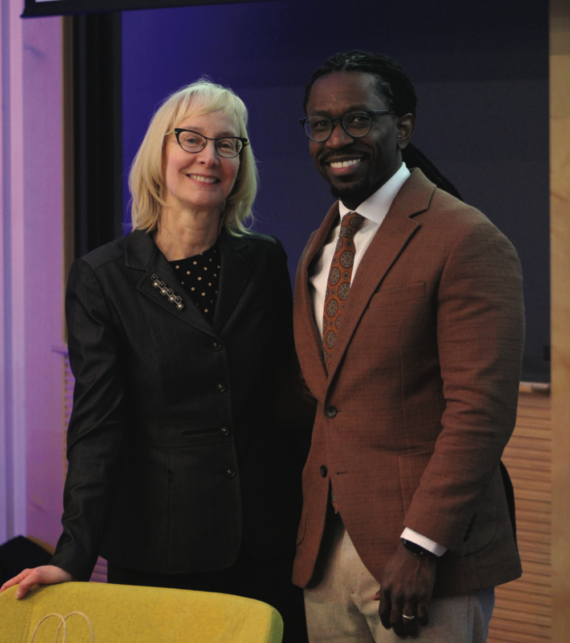
President Michaele Whelan poses for a picture with Dr.
Darren Wallace ’07, the keynote speaker for the event.
The MLK Legacy Celebration, a yearly tradition that began in 2015, was held in Hindle Auditorium on Feb. 10. The celebration, aimed at remembering the life and legacy of the well-renowned civil rights leader Dr. Martin Luther King Jr., brought in a full house of students, faculty and staff alike.
Dr. King is remembered for his work advocating for civil rights and the end of segregation through tactics such as civil disobedience, including boycotts, sit-ins and marches. His most prominent speech came at the March on Washington on Aug. 28, 1963, where more than 200,000 people marched through the streets of Washington, D.C. Led by prominent civil rights leaders, they gathered at the Lincoln Memorial to advocate for their common goals. These goals consisted of the passage of civil rights legislation, higher wages, no discrimination for workers based on race, ending segregation in schools and stronger protection of voting rights promised under the 14th Amendment. Here, King gave his “I Have a Dream” speech, which has gone down in history as one of the most iconic, influential speeches ever given.
But his work reaches out much further than that, as Dr. Darren Wallace ’09 made abundantly clear in his keynote address that he delivered at the celebration. Dr. Wallace is an associate professor of education policy and an associate professor of Africana studies at Brown University, as well as a Wheaton College alum.
The substance of his speech mentioned current attempts by the Trump administration to mock and erase Black history, along with their assault on educational institutions, but more so jabbed at the root of igno-rance: the overall decay of history as a whole. He used King’s
“I Have a Dream” speech as an example; it was popular and influential, but Dr. King likely wouldn’t have even improvised that portion of his speech had it not been for Mahalia Jackson, a prominent gospel singer who urged Dr. King to “Tell’em about the dream.”
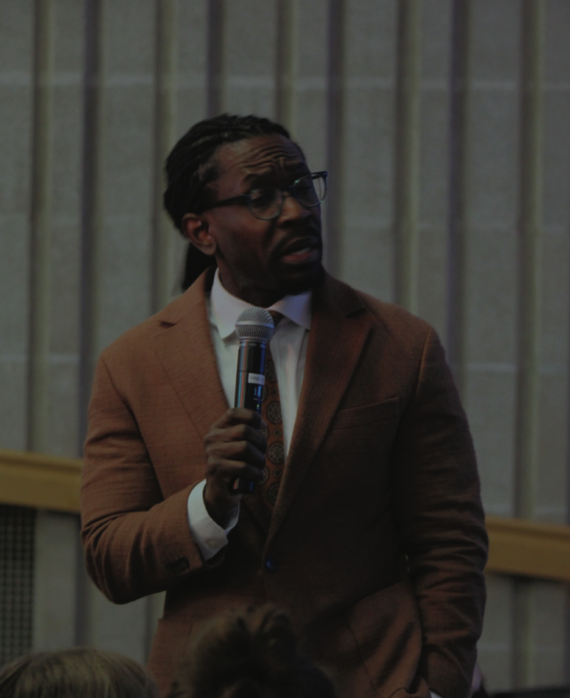
Dr. Darren Wallace ‘07 delivering his keynote address
at the MLK Legacy Celebration.
Furthermore, Dr. Wallace elaborated on his own expe-riences. He spoke about his exposure to Dr. King at a young age and his interactions with students in London and New York City, noting a clear limit on Black history studies in the educational system. He found that currently, the curriculum tends to silence the stories and sacrifices made by people Like Dr. King. “We should not undermine Dr. King’s message, as we cede power to fools” Dr. Wallace proclaimed.
All in all, Dr. Wallace’s address never sought to invalidate King’s speech but instead aimed to highlight that the moment may be one of the few familiar instances that people can recognize – that there were more pieces to the Civil Rights Movement and more advocates that made it so. When Dr. Wallace mentioned Rosa Parks and what happened following her arrest, he noted how silent sacrifice truly is, as she struggled financially afterward despite her celebrated actions on Dec. 1, 1955.
Dr. Wallace then wrapped up by leading everyone through an exercise: finding someone in the room they hadn’t met before and discussing what they would choose to do differently following the address. Wallace then left the crowd with, “No feel-good stories, as Dr. King wouldn’t want that.” Along with that, these instruc-tions: Demand democracy, defend diversity and dismantle educational inequality.
Other speakers at the event included President Michelle Whelan, the Black Student Association, Dr. Luis F. Paredes and Dean Raquel Ramos, the latter two of whom led the distribution of awards for the MLK Student Creativity Showcase and the MLK Legacy Awards.